
Here’s something that should stop you in your tracks. Right now, someone on the internet is listening to a song featuring your artist’s voice. They love it. They’re sharing it. They might even be paying for it. And your artist had absolutely nothing to do with it.
We’re not talking about a bootleg recording or a bad cover. We’re talking about AI-generated music so convincing that fans genuinely cannot tell it’s fake. A cloned voice. A brand new song. Zero involvement from the actual artist, and not a cent going to the label. This is happening today, at scale, and most of the industry still doesn’t have a real answer for it. That’s exactly why AI music detection has gone from a nice conversation to something labels need to be taking seriously right now.
It’s Not Just a Music Problem
To understand why music is in such a tough spot, it helps to zoom out for a second. Deepfakes aren’t new, and they’re not going away. Fake CEO audio has been used to authorize fraudulent wire transfers at major companies. AI-generated videos of politicians have been timed to drop right before elections to shift public opinion. Celebrity faces have been plastered into ads for products they’ve never heard of. Every industry is dealing with some version of this problem.
But here’s the thing. Film has SAG-AFTRA fighting for actor protections. Finance has compliance teams and fraud detection. Advertising has contracts, clearance processes, and legal departments that exist specifically to catch this stuff. They’re not winning every battle, but they have infrastructure. Music? Music is largely still figuring it out.
Why Music Gets Hit the Hardest
Think about what makes music different from every other creative industry. In film, if someone deepfakes an actor, they’re misrepresenting that person in someone else’s work. In music, the voice is the work. Cloning an artist’s voice doesn’t just copy their likeness, it recreates their entire artistic identity and uses it to make something new. Something that competes directly with the real thing.
And when it happens, two parties get hurt at the same time. The artist, whose voice and name are being used without their knowledge or consent. And the label, whose masters, licensing deals, and revenue streams are being bypassed entirely. Neither one gets tagged in the video. Neither one gets paid. Most of the time, neither one even knows it’s out there.
Then there’s the loophole that makes this even more complicated. A song built “in the style of” an artist using an AI-cloned version of their voice isn’t legally treated as a cover. It’s considered an original work. That one distinction means the standard copyright protections that would normally apply to a sample or a cover don’t kick in. There’s no clearance process, no paper trail, no clean mechanism to force a takedown. Anyone with access to the right tools can create it, upload it, and start collecting ad revenue the same day.
People Are Already Cashing In
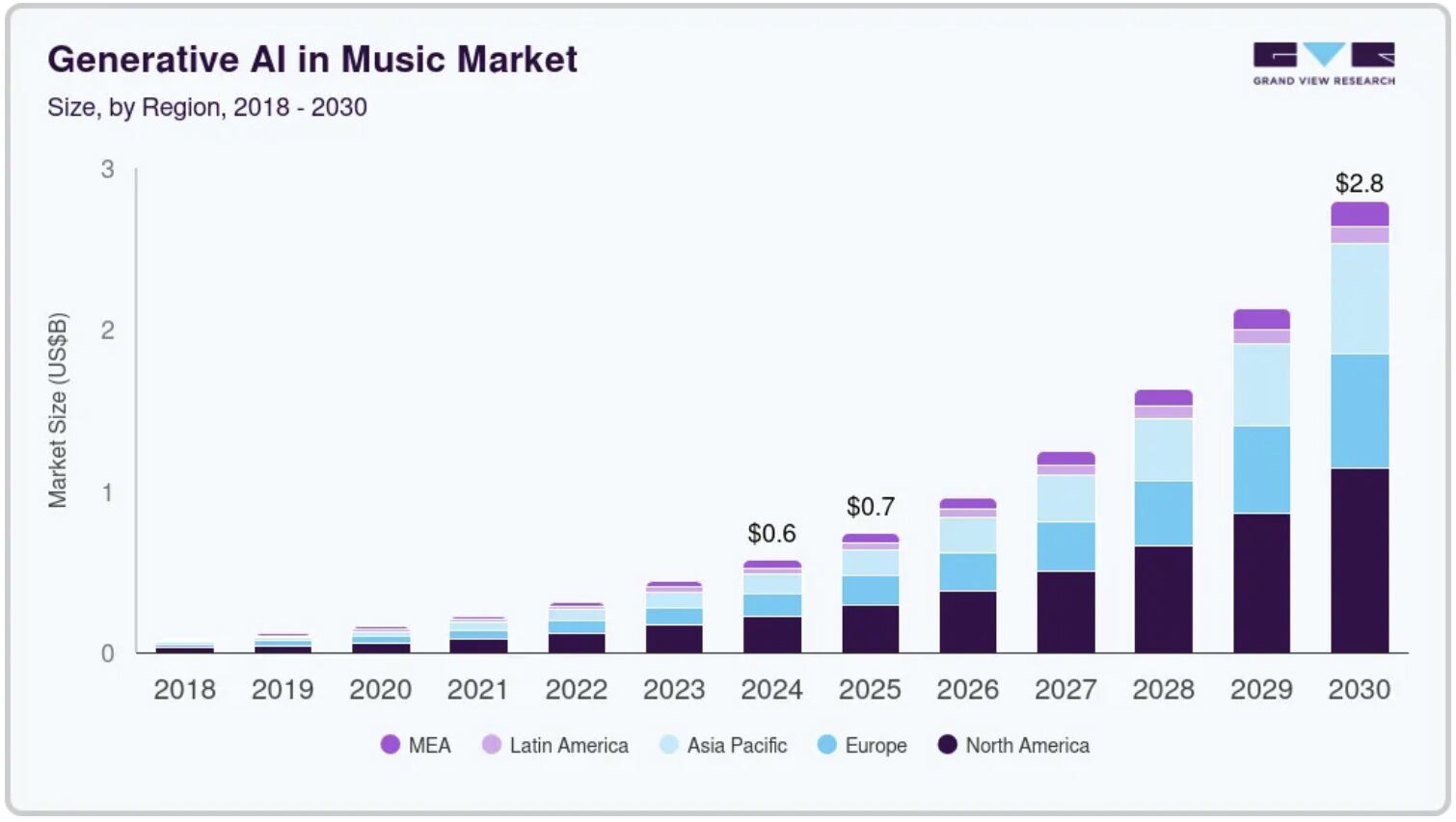
Globally, the ai music market is expected to be nearly $2.8 billion by 2030. That’s an increase of over 30% from 2023’s $440 million 1.
This is not a theoretical future problem. It’s happening right now. There are YouTube channels and TikTok accounts with hundreds of thousands of followers built entirely on AI-generated music using cloned artist voices. Gospel songs performed in the voice of a pop star who has no idea the track exists. Country versions of R&B hits. Viral lo-fi covers racking up millions of streams. Fans share this content because they like it, not because they’re trying to pirate anything. They just genuinely can’t tell.
The legal system is starting to catch up, and the cases are worth paying attention to. In June 2024, the RIAA filed landmark copyright infringement cases against AI music platforms Suno and Udio, with Universal Music Group, Sony Music Entertainment, and Warner Music Group all backing the suits. The allegation was blunt: both platforms trained their AI models on massive libraries of copyrighted recordings without asking, without crediting anyone, and without paying a single rights holder. Songs by Mariah Carey, The Jackson 5, and dozens of others were cited. The case against Suno alone was seeking up to $150,000 in damages per infringed work.
Suno’s legal defense is worth understanding because it signals where this fight is headed. Their argument is that the music their platform generates doesn’t actually “sample” any original recordings, so traditional copyright law doesn’t apply in the way labels are arguing. If that defense holds up in court, it would make it nearly impossible for rights holders to challenge AI music platforms on infringement grounds. The broader OpenAI copyright lawsuit picture tells the same story across the AI industry. Whether training on copyrighted material qualifies as fair use is being actively litigated right now, and there’s no clean answer yet.
Some of these cases are starting to resolve. Suno settled with Warner Music Group for $500 million, with WMG taking a stake in AI music development going forward. But settlements take time, and the content doesn’t wait. By the time a case wraps up, a fake track can have millions of streams and years of ad revenue already collected.
[See our previous post on music rights and what artists actually own]
What’s Actually Getting Lost
It’s easy to talk about this as a legal or technical problem, but at its core it’s a business problem. Every unlicensed AI track is a licensing deal that should exist but doesn’t. Every stream on a fake song is a stream that didn’t go to the real artist or the label. Sync fees, royalties, brand partnership value. All of it erodes when someone else can manufacture your sound without a contract.
And beyond the money, there’s the reputation angle. An artist’s voice can be used to create content they would never have agreed to, content that can confuse fans, damage relationships, and undermine years of careful brand building. Most labels and artists still don’t have a reliable way to monitor when this is happening, let alone stop it.
This Is Why Vermillio Built TraceID
The law will eventually catch up. But eventually it isn’t good enough when the damage is happening in real time. The most practical answer available right now is using AI to fight AI. Identifying fakes before they spread, monitoring catalogs continuously, and giving labels and artists the tools to actually act when something surfaces.
That’s exactly what TraceID was built to do. If you’re running a label and want to understand what’s out there using your catalog without permission, Vermillio can help you find it. Get in touch with us to get started.